Get instant access to the full report and key takeaways. Enter your email to continue.
No spam. One email about this report, then you’re done.
FlyRank
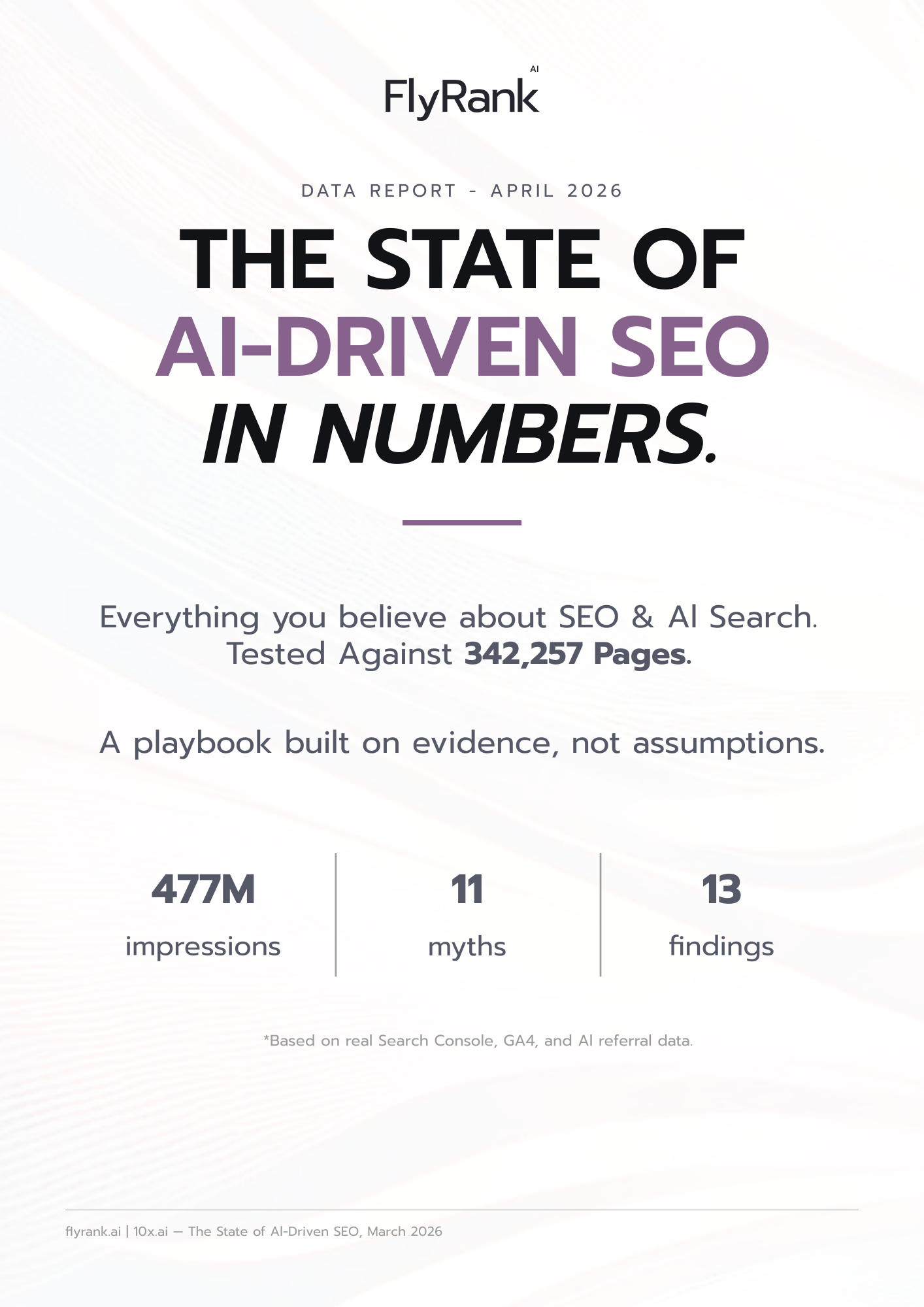
DATA REPORT · APRIL 2026
THE STATE OF AI-DRIVEN SEO
IN NUMBERS.
We checked 342,257 content pieces to find out what actually works in SEO right now — and what doesn't.
Results sections use the last 90 days; structural review uses Full available warehouse history (2025-10-13 to 2026-03-25).
flyrank.com
FlyRankExecutive Summary
What This Paper Covers
Start here for a quick plan: what we tested, what we found, and what to read first.
342,257
content pieces checked
45
total analyses performed
11
public myth tests
Recent results uses the last 90 complete days. Structural review uses Full available warehouse history (2025-10-13 to 2026-03-25).
AI sessions in this paper mean direct click-through visits from AI tools to the blog pages we track. They do not include the much larger citation or impression layer inside AI tools themselves.
The report is built to read in sequence: first the direct site findings, then a single myth-testing block,
then the technical appendix, then the operating playbook that leads into the FlyRank close. That order matters
because the myth pages reuse definitions introduced in the study setup, and the playbook works best after the proof is established.
Questions Tested In This Edition
TEST
How much do age, freshness, CTR, reader engagement, and channel mix explain site results?
The findings section establishes the observed patterns before any myth claim is tested.
TEST
Do common SEO beliefs hold once we compare them against the actual site data?
The myth section keeps every public myth test in one place.
TEST
What should teams do differently after reading the proof?
The playbook turns the strongest signals into a refresh and improvement workflow.
How To Use This Report
"Read the findings first, then the myth tests. Use the ML appendix for supporting detail, then finish with the playbook."
FlyRankTable of Contents
Table of Contents
The reading order is intentional: findings first, myth tests second, ML appendix third, action pages last.
Reading Shortcut
If you are short on time, read Executive Summary -> Core Findings -> Myth Tests -> Priority Actions. Use Study Setup for definitions and caveats, and use the ML appendix as supporting detail before the action pages.
FlyRankAbout This Study
About This Study
Recent results uses the last 90 days: 477,248,928 search impressions,
1,537,659 clicks, 1,672,511 sessions, and 17,693 AI sessions.
Structural review uses Full available warehouse history (2025-10-13 to 2026-03-25).
AI sessions here mean direct click-through visits from AI tools to the blog pages we track, not citations or impressions inside those AI products.
We asked simple questions: Does updating old content work? Does longer content rank better? Does AI-written
content get penalized? Then we let the numbers answer. Direct data comparisons lead the paper. Machine-learning
models appear in a bonus appendix.
Every finding is backed by the data. If something didn't hold up, we say so.
Every finding comes with a step-by-step action you can take this week.
FlyRankThe Dataset
342,257
content pieces checked
90-Day Impressions
477.2M
Last 90 complete days
90-Day Clicks
1,537,659
Organic search
Sessions Tracked
1.7M
GA4 recent window
AI Sessions
17,693
Known AI referrals
AI Share
1.06%
Of tracked sessions
Avg Health Score
22.4
Current FlyRank composite context
Full-History Impressions
625.8M
Full available warehouse history (2025-10-13 to 2026-03-25)
Full-History Clicks
2,126,739
Warehouse totals
Full-History Sessions
2.1M
164 active days
30-Day Trend vs Previous 30 Days
+66.7%
Impressions
+48.3%
Clicks
+33.4%
AI Sessions
Chart read: These show whether things got better or worse in the last month compared to the month before -- a quick pulse check, not a substitute for the 90-day comparisons in the main findings.
This dataset includes everything -- brand new articles, established pages, and struggling ones. That mix
is what makes these patterns real, not cherry-picked. Recent results uses the 90-day window, while
structural review uses Full available warehouse history (2025-10-13 to 2026-03-25). Query
relevance uses a separate window: Full available query history (2025-06-12 to 2026-03-24).
AI-session totals on this page represent direct blog traffic only -- visits where someone clicked through from an AI tool to a tracked page.
FlyRankStudy Scope & Proof Standard
Study Scope & Proof Standard.
Here's exactly what we measured and the rules we follow for interpreting the data.
This paper covers 477,248,928 impressions, 1,537,659 clicks,
1,672,511 sessions, and 17,693 AI sessions.
AI sessions here represent direct click-through visits to the tracked blog pages, not citation or impression share inside AI tools.
Reporting windows: Last 90 complete days for current performance, Last 30 complete days for short-term momentum, Full available warehouse history (2025-10-13 to 2026-03-25) for structural analysis, and Full available query history (2025-06-12 to 2026-03-24) for ranking-query relevance and query-coverage analysis.
Verified total
Value
Impressions
477,248,928
Clicks
1,537,659
Sessions
1,672,511
AI Sessions
17,693
Metric Windows
Last 90 complete days for current performance, Last 30 complete days for short-term momentum, Full available warehouse history (2025-10-13 to 2026-03-25) for structural analysis, and Full available query history (2025-06-12 to 2026-03-24) for ranking-query relevance and query-coverage analysis.
Data Source
This paper uses local recent-snapshot exports plus locally materialized full-history page and query exports. Each section is labeled with the window that matches the question being answered.
Proof Standard
Headline findings prioritize direct aggregate comparisons. ML pages are exploratory appendix material and do not override direct portfolio evidence.
Interpretation Rule
External SEO beliefs are treated as hypotheses, not proof. When direct portfolio evidence conflicts with industry narratives, the portfolio result wins.
FlyRankHow to Read This Paper
Understanding the Metrics
This paper leads with real search results numbers. We use our composite score for context, not as the main proof.
Health Score (0-100)
Impressions (30 pts) + position (30 pts) + CTR (20 pts) + scroll depth (20 pts). Higher = better doing content. This is a FlyRank metric, so major findings also show raw search numbers alongside it.
Position Tiers
Top 3: positions 1-3 (the best spots) | Page 1: positions 4-10 | Striking Distance: positions 11-20 (close to page 1 -- highest ROI zone) | Page 3-5: positions 21-50 | Deep: 50+ (very hard to find)
Age & Freshness
Age = how old the article is. Freshness = how recently it was updated. These are different things: a 2-year-old article updated last week is old but fresh. A 3-month-old article never touched since launch is young but stale.
AI Traffic
Visits where someone clicked through from an AI tool (ChatGPT, Perplexity, Gemini, Copilot, Claude, Meta AI) to one of the blog pages we track. Currently 1.06% of tracked sessions (17,693 of 1.7M). The number of times AI tools cite or surface this content is much larger -- these numbers track direct blog traffic only.
Optimization Flags
Labels FlyRank assigns to pages that need attention -- like 'Fix CTR' (people see it but don't click) or 'Zombie Page' (basically invisible). They tell you what to fix, not that the content is bad.
Trend Direction
Based on the last 30 days vs the 30 days before. Up: >10% growth. Down: >10% decline. Stable: within +/-10%. Flat: not enough data. New: published within 30 days.
Finding Tags
CONFIRMEDHypothesis validated by data
OPPOSITEData showed the opposite
MIXEDPartially true -- it depends
FALSEData proved this wrong
ML Techniques Used
We also ran machine learning models (clustering, prediction, and pattern detection) as a bonus appendix. Most published comparisons use large buckets, and smaller cells are called out where they appear. These models explore the data -- the main findings rely on direct number comparisons.
FlyRankMethod
Method & Limitations.
Data Sources
Data comes from Google Search Console, Google Analytics 4, and revenue data -- all stored in BigQuery with read-only access (we can look but never change the source data).
Study Scope
Last 90 complete days for current performance, Last 30 complete days for short-term momentum, Full available warehouse history (2025-10-13 to 2026-03-25) for structural analysis, and Full available query history (2025-06-12 to 2026-03-24) for ranking-query relevance and query-coverage analysis.
Proof Standard
Headline findings prioritize direct aggregate comparisons. ML pages are exploratory appendix material and do not override direct portfolio evidence.
212.4K active pages (with real sessions and impressions). Models: K-Means clustering (5 groups), Random Forest, Logistic Regression, PCA, and Decision Tree -- all tested on held-out data (80/20 split).
Statistical Approach
Correlations use Pearson r. Most main buckets are sized to avoid fragile one-off reads, and small cross-cells are flagged in the narrative where they remain. Percentiles use APPROX_QUANTILES. CTR is weighted (total clicks / total impressions). We do not report p-values or confidence intervals.
Coverage Windows
Full available warehouse history (2025-10-13 to 2026-03-25) for structural sections, Last 90 complete days for current-results sections, Last 30 complete days for momentum, and Full available query history (2025-06-12 to 2026-03-24) for ranking-query relevance.
Confounding Variables
Content age confounds model comparisons. Revenue tracking covers a subset of the site, so revenue claims are treated cautiously. AI referral detection may miss some sources, and the query-history window is shorter than the page-history window.
Limitations
This is a pattern study -- we found patterns, not proof of cause and effect. Health score is our own metric, not a Google standard. Query data uses a shorter window than page data. Reader engagement time comes from aggregated fields, not individual session replay.
FlyRankFinding #1 -- CONFIRMED
The Anatomy of Growing Content.
What do growing pages have in common? And what's different about the ones losing traffic?
We split every page into two groups: gaining traffic vs losing traffic. The clearest difference is age.
Growing pages are younger and already a little more visible in search. Length is almost the same.
1487
avg words (growing)
1481
avg words (declining)
185d
avg age (growing)
228d
avg age (declining)
Direction
Count
Words
Age
Avg Imp
Avg Pos
Health
up
74.5K
1.5K
185d
2.9K
16
36.6
down
46.2K
1.5K
228d
2.6K
15.9
32.7
Word count is almost the same in both groups (1.5K vs 1.5K).
Age is the real gap. Growing pages are 18.9% younger (185 vs 228 days).
Declining pages aren't necessarily bad -- many still get traffic. They're just older and losing momentum.
Improve pages that already earn impressions
Why: The biggest gap here is age, not length, so start with pages Google already sees and keep them useful
How: List pages with real impressions that still feel thin or incomplete, then add missing subtopics, examples, definitions, and comparison sections instead of padding.
Expected: Gives already-visible pages a better chance to keep growing instead of fading out.
Measure: Track impressions, clicks, and average position 30 and 60 days after the update.
Review aging pages before they drift into decline
Why: The falling cohort is older on average and more likely to have missed a recent refresh cycle
How: Create a quarterly review for pages that are around 6-9 months old, then prioritize the ones that once performed well but have started to flatten.
Expected: Protects pages with existing search visibility before the decline becomes expensive to reverse.
Measure: Track refresh coverage and 30-day impression change for reviewed versus unrevised pages.
FlyRankFinding #2 -- CONFIRMED
The Content Results Curve.
Every piece of content has a life cycle. It peaks around 61-90 days, then gets weaker after about 9 months if nobody keeps it sharp.
Health Score by Content Age (Days)
0-14
26.2
n=3.3K
15-30
34.1
n=13.4K
31-60
36.8
n=22.5K
61-90
37.2
n=18.2K
91-180
34.5
n=29.8K
181-270
31.0
n=82.7K
271-365
29.6
n=21.0K
365+
35.5
n=21.4K
It takes about 60-90 days for Google to fully discover and rank a new page -- that's when
results peaks at 37.2 health.
After that, results gradually declines. By 271-365 days, health drops to 29.6 as the
content gets older. But old does not mean dead: the 365+ group still averages
35.5 health.
Create a review cycle before pages hit the 9-12 month mark
Why: Results starts declining after 270 days -- catch pages before the drop
How: Schedule editorial reviews for pages approaching that age, then refresh the ones that already have traffic or strategic value before they go stale.
Expected: Preserves the search visibility older pages have already earned.
Measure: Track refreshed-page coverage and compare impression retention before and after the review window.
FlyRankFinding #3 -- CONFIRMED
Click Capture by Position Tier.
The higher you rank, the more clicks you get -- and the drop-off is steep.
Weighted CTR by Position Tier
Top 3
0.420%
Page 1 (4-10)
0.340%
Striking
0.325%
Page 3-5
0.163%
Deep
0.050%
0.420%
weighted CTR in top 3
0.340%
weighted CTR on page 1
88%
drop from top 3 to deep
The takeaway: improving a page already on page 1 gets you more clicks
faster than trying to rescue a page buried on page 5. Once content drops off the first page,
click capture shrinks fast.
Refine search snippets on pages that already rank on page 1
Why: Small ranking and snippet gains on already-visible pages usually convert into click lift faster than rebuilding weak pages from scratch
How: Review pages ranking on page 1, tighten titles and descriptions around clear intent, and test more specific promise statements instead of generic headings.
Expected: Improves click capture on search visibility you already own.
Measure: Track weighted CTR, clicks, and average position for the revised group over the next 30 days.
FlyRankFinding #4 -- CONFIRMED
The Freshness Multiplier.
This section combines two reads: freshness-window growth/decline ratios and a separate 365+ refreshed-vs-stale lift comparison.
Growth-to-Decline Ratio by Freshness Window
0-30
1.0:1
n=68.3K
31-90
5.4:1
n=18.8K
91-180
2.0:1
n=16.5K
181-360
3.0:1
n=16.2K
361+
37.2:1
n=802
Pages updated 0-30 days ago are too new to read reliably. But at 31-90 days, freshness is the strongest measured growth signal
-- 5.43:1 growth-to-decline ratio.
Pages untouched for 181-360 days show clearly stale behavior at 3.02:1, while the 361+ bucket spikes to 37.19:1 -- but that's a tiny sample with only 21 declining pages, so don't read too much into it.
Separate cohort check (365+ pages): among pages older than a year, the cohort refreshed in the last 30 days jumped from
23 to 37 health (1.6x boost)
and from 82 to 4.2K impressions
(52x) versus old pages last updated 181-360 days ago.
1.6x
365+ refresh health lift
52x
365+ refresh impression lift
5.43:1
31-90d growth:decline ratio
Chart read: Read 31-90 as the strongest stable freshness-window signal. The 1.6x and 52x cards are a separate 365+ refreshed-vs-stale cohort comparison. The 361+ bar is present because it exists in the local sample, but its 37.19:1 ratio is unstable: 781 growing pages versus only 21 declining.
Run a recurring refresh program for mature pages
Why: The strongest stable freshness-window ratio is 31-90 (5.43:1), and the separate 365+ refreshed cohort shows 1.6x health and 52x impression lift
How: Review older pages with proven historical search visibility, refresh outdated facts and examples, add missing subtopics, and resubmit the strongest updates for recrawl.
Expected: Lifts mature pages from roughly 23 health to 37 and materially improves impression potential.
Measure: Track impressions, clicks, and average position on refreshed mature pages versus comparable untouched pages.
FlyRankFinding #5 -- CONFIRMED
Reader Engagement and Search Visibility Move Together.
High scroll + high reader engagement = +16.1 health points. Search visibility consistency compounds the effect.
How These Buckets Work
Scroll depth buckets use the share of the page consumed: Low <30%, Mid 30-59%, High 60%+. Reader engagement-rate buckets use Low <45%, Mid 45-69%, High 70%+. Search visibility here means how many of the last 90 complete days the page recorded at least one search impression.
Health Score by Scroll Depth x Reader Engagement Rate
Scroll \ Engage
Low (<45%)
Mid (45-69%)
High (70%+)
Low (<30%)
32.0
36.5
26.0
Mid (30-59%)
41.6
45.1
50.0
High (60%+)
40.3
46.3
48.1
Health by Search Visibility Consistency
consistent
47.2
n=40.0K
frequent
33.8
n=20.5K
intermittent
35.2
n=56.3K
sporadic
25.8
n=95.6K
Pages where people scroll deeper and stay engaged score 48.1 health. Pages people
bounce from score 32. That 21.4-point gap is why we use search visibility as context in this paper.
Improve scanability on pages that already earn consistent search visibility
Why: High-reader engagement pages score 16.1 health points higher than low-reader engagement ones
How: Use clearer sections, jump links, tighter intros, and visuals that make the page easier to scan and understand.
Expected: Supports the reader engagement patterns associated with stronger search visibility.
Measure: Track scroll depth, clicks, and average position changes on the revised group.
FlyRankFinding #6 -- CONFIRMED
AI Traffic: A Different Signal.
AI traffic does not line up perfectly with normal Google traffic. Here is the pattern we can actually measure.
AI Bucket
Count
Health
Avg Imp
Avg Pos
high_ai
2.8K
38.5
5.2K
14
some_ai
2.4K
48.9
20.1K
18.1
no_ai
207.1K
32.8
2.0K
14.3
Metric
Standard SEO
Our AI SEO
Traffic Mix
Search 88.99% | AI 0.38%
Search 98.94% | AI 1.06%
AI Share
~0.1% typical site traffic
1.06% (17.7K of 1.7M)
Scale Gap
Google 99.63% vs ChatGPT 0.37%
OpenAI 4.3K vs Gemini 2.3K (30d)
Referral Vol
AI 1.13B vs Google 191B
High-AI pages: 2.6x impressions vs no-AI
AI Traffic Share (%) -- Monthly
Oct 25
1.9%
Nov 25
1.6%
Dec 25
1.8%
Jan 26
2.2%
Feb 26
1.7%
Mar 26
0.6%
Note: The most recent month may reflect incomplete data at the time of this export. Read the trend from completed months.
AI Referral Providers (Local Last-30d Breakdown)
OpenAI
4.3K
Gemini
2.3K
Perplexity
823
Copilot
113
Claude
87
1.06%
AI share of site sessions
1.57%
AI page rate in full export
1.9x
OpenAI vs Gemini (30d)
Pages with AI referrals do not look exactly like the pages that win normal search.
In this dataset, the high-AI group averages 2.6x impressions and almost identical Google positions
than the no-AI group. So AI visibility and Google visibility overlap, but they are not the same thing.
These numbers track direct blog traffic only -- visits where someone clicked through from an AI tool.
The citation and impression reach across AI platforms is much larger.
AI click-throughs are still 1.06% of tracked sessions (17.7K of 1.7M).
Growing, but still a small share of measured visits. In this export, the highest AI referral rates show up in commercial intent
and the 5K+ length bucket. Compared with Ahrefs' 0.1% typical AI-referral benchmark,
this site's tracked AI share is about 10.6x higher.
External benchmark note: Similarweb reports AI referrals are growing fast (+357% YoY) even while remaining small versus search volume.
Monitor AI referrals separately -- they're a different channel
Why: AI traffic is still small, but the pages that get it do not look exactly like normal search winners
How: Review high-impression pages, make key facts easy to scan, and track AI referrals separately from search clicks.
Expected: Prepares your content for AI search visibility without pretending the channel is bigger than it is.
Measure: Track AI session share, provider mix, and page-level AI referral rates alongside standard search metrics.
FlyRankFinding #6b -- NEW ANALYSIS
AI Traffic Up Close: Source, Behavior, and Intent.
AI sends about 1.06% of visits today. Here is who sends them, how those visits behave, and what kind of page each tool prefers.
How These Numbers Are Computed
Volume and intent come from full-history AI clicks. Visit-quality (time on page, engagement rate, pages per visit, quick-exit rate) comes from the full GA4 warehouse window. We focus on the three AI tools with enough visits to say something useful: ChatGPT, Gemini, and Perplexity.
AI visits
25.0K
full history
Portfolio share
1.06%
of all visits
ChatGPT share
59%
of AI sessions
AI vs organic
1.37x
stickier per visit
Who Sends The AI Visits?
ChatGPT
59.1%
Gemini
24.0%
Perplexity
14.6%
Other AI
2.3%
Chart read: ChatGPT is the big one. Gemini is the clear #2. Perplexity is smaller, but still meaningful.
How Often Do Visits Actually Engage?
Share of visits that click, scroll, or stay — not just bounce.
ChatGPT
10.7%
Gemini
11.1%
Perplexity
10.3%
Best pages / visit
Gemini 2.08
Highest quick-exit
ChatGPT 80%
Visit Behavior Per AI Tool
Avg time on page
seconds — higher is better
ChatGPT
8.6s
Gemini
6.8s
Perplexity
9.7s
Engagement rate
% of visits that stay — higher is better
ChatGPT
10.7%
Gemini
11.1%
Perplexity
10.3%
Pages read per visit
higher is better
ChatGPT
1.80
Gemini
2.08
Perplexity
1.95
Scrolls per visit
higher is better
ChatGPT
0.24
Gemini
0.18
Perplexity
0.18
Visits per person
higher = more return
ChatGPT
1.03
Gemini
1.02
Perplexity
1.05
Quick-exit rate
lower is better
ChatGPT
79.5%
Gemini
75.5%
Perplexity
75.8%
Side-by-side read of the three AI tools across the full GA4 warehouse window. "Engagement rate" is GA4's definition — a visit that stays more than 10 seconds, scrolls, or reads a second page. "Quick-exit rate" is a stricter measure: the share of a source's visits that landed on pages where no visit engaged at all.
Quick read: Perplexity readers spend the most time on the page (9.7s). Gemini has the highest engagement rate (11.1%). Gemini sends the deepest visits (2.08 pages each). ChatGPT has the most quick-exits (79.5%).
What Kind Of Page Does Each LLM Like?
LLM
Info
Comm
Trans
ChatGPT
45.6%
22.4%
25.3%
Gemini
48.9%
24.3%
23.2%
Perplexity
45.6%
22.5%
28.0%
Chart read: Each row is one AI tool. Each column is the share of its visits going to informational (Info), commercial (Comm), or transactional (Trans) pages.
ChatGPT
broad / mixed
Gemini
more informational pages
Perplexity
more transactional pages
The read is simple. ChatGPT sends most AI clicks (59%) and looks broad.Gemini leans toward informational pages and drives the highest engagement rate.Perplexity leans toward transactional pages and sends the longest, deepest visits.AI visits overall are 1.37x stickier than organic per visit.
Treat these as tuning signals, not hard rules.
Tune content and tracking to each AI tool's strengths
Why: Each AI tool sends a distinct kind of visit -- Perplexity readers stay longest, Gemini readers engage most, ChatGPT sends the most volume but bounces fastest. A one-size-fits-all content plan hides those differences.
How: Track AI referrals per provider, mark which pages win each channel, and align new content formats to each tool's intent lean: informational depth for Gemini, transactional specificity for Perplexity, broad fact-rich articles for ChatGPT.
Expected: Captures more durable visits from each AI channel without treating them as one interchangeable source.
Measure: Track time on page, engagement rate, pages per visit, and quick-exit rate per AI provider month-over-month.
FlyRankFinding #7 -- CONFIRMED
The Winning Combinations.
The easiest win: target topics where people are ready to buy and where competitors haven't shown up yet.
Average Health by Intent x Competition Level
transactional x LOW
36.4
n=24.1K
informational x LOW
34.1
n=98.5K
commercial x LOW
34.1
n=23.3K
transactional x MEDIUM
31.7
n=4.4K
commercial x MEDIUM
31.4
n=3.9K
transactional x HIGH
30.5
n=10.3K
commercial x HIGH
29.9
n=5.4K
navigational x LOW
29.0
n=414
Buy-ready intent + low competition leads every metric in this
site: 36.4 health and 3.8K impressions.
Learning + low competition pages average 34.1 health -- still solid, but
the buy-ready topics clearly outperform.
Among page-1 content, the strongest word-count bucket is 3500+ words (44.8 health, 2.4K impressions). But longer content only wins when the topic genuinely needs that depth -- padding doesn't help.
Reserve a larger share of the calendar for lower-competition commercial or buy-ready topics
Why: Those topics do better the site average in both search visibility and FlyRank health context
How: Map topics where the reader is already comparing options, then target the versions where the current result pages are beatable.
Expected: Improves the odds of reaching page 1 faster and capturing more useful demand.
Measure: Track impressions, clicks, and average position by intent class over the next publishing cycle.
FlyRankFinding #8 -- CONFIRMED
The Age-Freshness Matrix.
How old is the content and how recently was it updated? This matrix shows how those two factors combine.
Important: What 'Content Update' Means Here
In this matrix, an update is detected through internal workflow logic and algorithmic signals, not one fixed edit type. Updates may include meta title/description changes, body-content edits, internal-linking changes, and visual/UX changes such as images, widgets, or layout elements. One page can have one or many of these update types.
Health Score Heatmap: Age Tier x Freshness Tier
Age \ Fresh
0-30
31-90
91-180
181-360
361+
0-14
26.2 n=3.3K
-
-
-
-
15-30
34.1 n=13.4K
-
-
-
-
31-90
39.0 n=14.9K
35.8 n=25.8K
-
-
-
91-180
36.9 n=14.6K
26.7 n=5.1K
35.0 n=10.1K
-
-
181-365
35.9 n=47.8K
16.5 n=8.5K
28.9 n=21.2K
27.6 n=26.3K
-
365+
37.0 n=18.4K
-
-
23.1 n=1.9K
32.5 n=1.1K
Four key zones:
1. Growth Engine (31-90d age, recently updated): 39.02 health.
2. Refresh Winners (365+, updated within 30d): 36.98 health.
3. Decay Zone (181-365d, untouched 6-12 months): 27.57 health.
4. Survivors (365+, 361+ stale): 32.48 health -- very small sample.
The biggest takeaway from this study: a 1-year-old article that you update
can compete with brand-new content (36.98 vs 39.02 health).
You do not always need net-new content -- you often need updated content on proven pages.
FlyRankFinding #9 -- NEW REVIEW
Captured Traffic Value.
The defensible proxy is clicks x CPC, not impressions x CPC.
Click-Equivalent Value by Intent
informational
$480.2K
commercial
$261.3K
transactional
$355.7K
navigational
$3.1K
Intent
Pages
Clicks
CPC
Value
informational
195.0K
1.1M
$2.79
$480.2K
commercial
45.3K
386.7K
$2.19
$261.3K
transactional
50.5K
576.1K
$2.29
$355.7K
navigational
1.6K
2.5K
$7.62
$3.1K
$1.1M
captured click-equivalent value
$389.9M
impressions x CPC upper bound
0.28%
captured vs upper bound
How much is your organic traffic worth? We multiply actual clicks x what those
clicks would cost in Google Ads (CPC). The click-based value is 0.28% of the impressions x CPC number -- that gap is exactly
why you should never use the inflated version as a headline.
Use click-equivalent value to rank optimization candidates
Why: It preserves CPC economics without pretending every impression is worth a click
How: Prioritize visible pages where clicks already exist and the underlying CPC is meaningful.
Expected: Improves prioritization quality when traffic counts alone hide value density.
Measure: Track click lift, weighted CPC, and click-equivalent value before and after improvement.
FlyRankFinding #10 -- MIXED
AI Model Results.
Neither OpenAI nor Gemini content is universally better. When we compare content of the same age, each model wins in different categories.
Provider
Count
Health
Avg Imp
Avg Pos
OpenAI
73.7K
32.54
1.4K
13.9
Gemini
72.1K
33.51
2.1K
11.5
Age-Controlled Cohort Health
0-14 - Gemini
24.7
n=2.5K
0-14 - OpenAI
31.3
n=749
15-30 - Gemini
34.3
n=11.9K
15-30 - OpenAI
32.5
n=1.5K
31-90 - Gemini
36.7
n=30.9K
31-90 - OpenAI
38.9
n=5.4K
91-180 - Gemini
34.6
n=14.4K
91-180 - OpenAI
33.9
n=5.5K
181-365 - Gemini
25.4
n=12.4K
181-365 - OpenAI
30.7
n=51.9K
365+ - OpenAI
39.1
n=8.7K
OpenAIGemini
Once we control for age, Gemini leads some cohorts and OpenAI leads others --
the AI model matters less than how well you edit and publish the content.
This dataset does not support a blanket penalty tied only to AI usage.
Note: Gemini was not in use across the full history of this site. Older age tiers may have no Gemini data because the tool was adopted later. Compare within the same age cohort to get a fair read.
Compare content systems within the same age and topic cohorts
Why: The model picture changes once age mix is controlled
How: When you test writing systems or prompts, review them inside the same publication window and topic class.
Expected: Produces cleaner decisions about which production workflow actually performs better.
Measure: Track impressions, average position, and health context within matched cohorts at 30, 60, and 90 days.
FlyRankFinding #11 -- AI CONTENT TRENDS
AI Content Trend Direction.
This shows how AI-written content moved in our dataset over time. We do not just look at the whole pile of traffic. We also look at what happens per page and per client.
Fallback mode: computed from monthly totals
Client-level monthly trend summary fields were not available in this export. This section uses raw monthly totals from monthlyTrends and computes per-active-page normalization from impressions and active content.
+52.1%
impression growth per active page
+1482.7%
total monthly impression growth
+691.4%
total monthly click growth
+1453.6%
total monthly AI-session growth
Impressions per Active Page (Monthly)
Chart read: Computed as monthly impressions divided by monthly active content. Each active page moved from 722 impressions in 2025-10 to 1.1K in 2026-03.
AI Sessions (Monthly Totals)
Chart read: From 2025-10 to 2026-03, AI sessions moved from 422 to 6.6K.
From 2025-10 to 2026-03,
impressions per active page changed +52.1%,
total impressions changed +1482.7%,
clicks changed +691.4%,
and AI sessions changed +1453.6%.
This fallback keeps the direction signal factual for this export while avoiding fabricated client-level claims.
FlyRankFinding #12 -- NEW ANALYSIS
Keyword Drift & Shift.
You pick a keyword, publish content for it, then Google decides what the page actually ranks for. Here's how often that matches.
51.5%
on-target (25%+ from keyword)
48.5%
drifted (<25% from keyword)
11.5%
zero matching queries
How Much Traffic Comes From Your Target Keyword
0%
10.1K pages
n=10.1K
0–5%
7.6K pages
n=7.6K
5–10%
7.0K pages
n=7.0K
10–25%
17.6K pages
n=17.6K
25–50%
22.3K pages
n=22.3K
50–75%
14.6K pages
n=14.6K
75–100%
8.0K pages
n=8.0K
On-Target Pages
Avg Impression Share
53.6%
Avg Queries Per Page
125.6
Matching Queries
18.5
Drifted Pages
Avg Impression Share
8.8%
Avg Queries Per Page
185
Matching Queries
9.3
About half the site (51.5%) gets 25% or more of its
traffic from the target keyword. The other half drifted -- Google sends them traffic for different queries.
And 11.5% of pages get zero impressions from any query matching their keyword.
Drifted pages aren't failing -- they rank for 185 queries on average.
The median page gets 25.9% of its traffic from its target keyword. The top 10% get 73%+.
Average Impressions by Keyword Match Share
0% match
161
n=9.8K
0–5% match
6.1K
n=7.5K
5–10% match
6.5K
n=7.1K
10–25% match
5.7K
n=17.9K
25–50% match
5.0K
n=23.0K
50–75% match
4.2K
n=13.9K
75–100% match
1.7K
n=8.0K
Keyword match share does not predict impressions, clicks, or health score.Drift is not a problem -- it's a feature. The best-doing pages capture
their target keyword plus a wide net of related queries. Pages too tightly matched to one keyword have less total reach.
Don't chase 100% keyword match -- aim for broad relevance
Why: Pages with 5–10% keyword match do better tightly-matched pages
How: Write content that covers the full topic around your keyword, not just the exact phrase. Include related questions, comparisons, and subtopics.
Expected: Broader content earns more impressions while still capturing the target keyword as one of many traffic sources.
Measure: Track total impressions and query count per page. A healthy page should rank for dozens of queries, not just the one you targeted.
FlyRankFinding #12 continued
Drift vs Performance.
Does matching your target keyword predict better performance? We checked impressions, clicks, CTR, and health score.
Average Impressions by Keyword Match Share
0% match
161
n=9.8K
0–5% match
6.1K
n=7.5K
5–10% match
6.5K
n=7.1K
10–25% match
5.7K
n=17.9K
25–50% match
5.0K
n=23.0K
50–75% match
4.2K
n=13.9K
75–100% match
1.7K
n=8.0K
Chart read: This shows average impressions per page, grouped by how much of the page's traffic comes from its target keyword. Higher keyword match does not mean more traffic.
Average Health Score by Keyword Match Share
0% match
28.9
n=9.8K
0–5% match
41.4
n=7.5K
5–10% match
40.3
n=7.1K
10–25% match
40.0
n=17.9K
25–50% match
39.8
n=23.0K
50–75% match
39.4
n=13.9K
75–100% match
34.1
n=8.0K
5–10%
highest impressions bucket
75–100%
highest CTR bucket
160.5
avg impressions at 0% match
Keyword match share does not predict impressions, clicks, or health score.
The Pearson correlations are near zero: impressions -0.039, clicks -0.006, health -0.013.
Only CTR shows a slight positive trend (0.033).
Pages with 0% keyword match average only 160.5 impressions.
The sweet spot is 5–10% match at 6.5K avg impressions and 40.3 health.
Pages tightly locked onto one keyword (75-100%) average only 1.7K impressions.
Drift is not a problem -- it's a feature.
Don't chase 100% keyword match -- aim for broad relevance
Why: Pages with 5–10% keyword match do better tightly-matched pages by 4.8K impressions on average
How: Write content that covers the full topic around your keyword, not just the exact phrase. Include related questions, comparisons, and subtopics.
Expected: Broader content earns more impressions while still capturing the target keyword as one of many traffic sources.
Measure: Track total impressions and query count per page. A healthy page should rank for dozens of queries, not just the one you targeted.
FlyRankFinding #13 -- (UN)EXPECTED TRUTH
(Un)Expected Truth: Search Market Share.
AI is growing fast. But search is still much bigger today. And search intent is not the same as AI intent.
6.4B
Google referrals/day
37.7M
AI referrals/day
169x
Google scale gap
Digital Query Share (Q4 2025)
Google Search
77.9%
ChatGPT
17.1%
Other
5.8%
Intent Split (Google vs ChatGPT)
NavigationalGoogle 93% | ChatGPT 3%
InformationalGoogle 71% | ChatGPT 23%
TransactionalGoogle 90% | ChatGPT 5%
Generative/CreativeGoogle 29% | ChatGPT 64%
GoogleChatGPT
Platform
MAU (Global)
Avg Session
Google Search
5.0B
6m 12s
ChatGPT
858.0M
13m 09s
Other
580.0M
4m 33s
Hard truth: Google is still in billions per day, while AI is still in millions per day. So AI is growing, but it is not replacing search right now.
Second truth: intent does not match 1:1. Google dominates navigational and transactional demand.
ChatGPT is stronger in generative/creative demand. Keep two playbooks: one for search demand capture, and one for AI answer visibility.
FlyRankMyth Tests
11 SEO beliefs tested.
We tested common SEO assumptions against our data. Here is what each one turned out to be.
2
confirmed
3
opposite
4
mixed
2
false
OPPOSITE
High monthly search volume is a reliable traffic forecast
Monthly search volume behaves more like a competition signal than a page-level traffic ceiling in this portfolio.
OPPOSITE
Optimization flags mean failure, not an opportunity
Flagged pages are often the visible pages worth improving. Read flags as workflow priority, not as a claim that more flags are inherently better.
CONFIRMED
Word count helps when it buys better coverage
Longer pages can win more demand when they answer more questions. Extra words without relevance do not create results by themselves.
FALSE
AI-generated content is not penalized by default
This dataset does not show a blanket penalty for AI use. Editing quality, topic fit, and publishing process matter more.
CONFIRMED
Keyword difficulty matters, but mostly as a growth environment signal
Lower-competition topics are safer, but difficulty does not work as a simple yes-or-no predictor by itself.
MIXED
Freshness amplifies quality rather than replacing it
Refreshing strong pages works. Refreshing weak pages helps less. The best observed health cell is not always the freshest one.
MIXED
Publishing more content helps -- but a strong library beats a busy one
High-velocity publishers average better health, but the single healthiest brand publishes nothing. Volume without quality is noise.
Every step up in CPC predicts worse health, fewer impressions, and worse position. The cheapest keywords outperform across every organic metric.
FALSE
Engagement metrics drive rankings
High engagement correlates with health but shows near-zero correlation with position. Position drives engagement opportunity, not the reverse.
MIXED
No single search intent type is a performance silver bullet
Transactional intent leads slightly in health, but informational content grows faster and dominates volume. Unclassified content is the real underperformer.
MIXED
Consistent visibility predicts health -- but not growth
The most visible content has plateaued. The real growth engine is moderate consistency, where content has proven viability but still has room to climb.
FlyRankMyth #1 -- OPPOSITE
"High Search Volume = More Traffic."
Search-volume numbers from SEO tools are rough demand estimates. When you compare them against actual page traffic, they still fail as reliable traffic forecasts.
Why The Adjusted Comparison Matters
FlyRank Search Volume uses third-party search-volume data as an external demand signal. Because page traffic is shown in a 90-day window here, we also show 90-day impressions divided by three as a directional apples-to-apples check.
Share of Pages Beating Search Volume
1-100
65%
n=96.5K
100-1K
34%
n=16.2K
1K-10K
7%
n=3.8K
10K+
1%
n=330
Bucket
Count
Avg Search Volume
90d Imp
90d / 3
Beat Search Volume
1-100
96.5K
23
2.5K
837
65%
100-1K
16.2K
306
2.9K
982
34%
1K-10K
3.8K
2.8K
2.2K
748
7%
10K+
330
30.3K
3.0K
997
1%
58.59%
monthly-adjusted pages beating volume
68.2%
pages beating volume (90-day)
50.32%
pages beating volume (full history)
The adjusted comparison is the cleaner directional read: 58.59% of pages still beat stored search volume after dividing 90-day impressions by three.
The correlation signal between search volume and actual traffic is effectively zero.
Search volume tells you more about competition than about the traffic a page will actually earn.
Use monthly search volume as a rough guide, not a traffic prediction
Why: Actual page traffic only weakly correlates with keyword volume numbers
How: Start with beatable demand and clear intent match. Treat monthly search volume as a competition signal, not an expected traffic ceiling.
Expected: Helps you find topics where real upside is higher than keyword tools suggest.
Measure: Track average position, page-level impressions, and the share of pages exceeding their keyword-volume benchmark.
FlyRankMyth #2 -- OPPOSITE
"Content With Flags Is Failing."
Pages with diagnosed issues aren't failing -- they're visible enough to measure. That makes them your best improvement targets.
About These Flags
These are FlyRank's internal optimization flags: diagnostic labels we assign to pages with enough search visibility to measure. They are not external quality signals from Google.
Health Score by Number of Active Optimization Flags
0 flags
33.1
n=95.0K
1 flags
34.6
n=74.8K
2 flags
28.0
n=36.5K
3 flags
45.1
n=5.1K
4 flags
46.7
n=869
5 flags
46.1
n=81
Pages with 3+ flags materially do better than the zero-flag cohort (45.1 vs 33.1).
A page needs to be visible enough for us to even detect problems.
A page with a specific measurable problem is often more valuable than a page nobody sees.
Flags = opportunity, not failure.
Treat measurable improvement issues as priority opportunities
Why: A page with a specific diagnosed issue is usually easier to improve than a page with no measurable demand
How: Review visible pages for the exact problem they show, then fix that issue first instead of rewriting the whole asset.
Expected: Focuses effort on pages where the upside is knowable and more immediate.
Measure: Track impressions, clicks, and average position before and after each targeted fix.
FlyRankMyth #3 -- CONFIRMED
"Longer Content Ranks Better."
In this dataset, the 5K+ bucket has the highest average impressions and query coverage, but the pattern across buckets is uneven and descriptive rather than causal.
Average Impressions by Word Count Bucket
<1K
1.6K
n=230.4K
1K-1.5K
690
n=50.7K
1.5K-2K
932
n=39.0K
2K-2.5K
433
n=8.0K
2.5K-3.5K
625
n=59.0K
3.5K-5K
1.2K
n=28.6K
5K+
9.8K
n=11.5K
Words
Pages
Avg Imp
Avg Sec
Queries
Off-Target %
<1K
230.4K
1.6K
0.49
170.5
69.4
1K-1.5K
50.7K
690
1.41
63.58
73.35
1.5K-2K
39.0K
932
1.62
74.06
69.33
2K-2.5K
8.0K
433
1.81
41.32
76.76
2.5K-3.5K
59.0K
625
1.67
66.35
66.61
3.5K-5K
28.6K
1.2K
1.82
79.17
65.75
5K+
11.5K
9.8K
3.13
466.86
80.46
The 5K+ bucket leads on both average impressions and average query count, but the trend is not linear across all word-count tiers.
Word count has a moderate relationship with query coverage (correlation signal: 0.4127) and a near-zero relationship with reader engagement time (correlation signal: -0.0565).
Only 6.17% of pages have their top query as an exact keyword match, while 60.97% are led by an off-target query.
Use depth to cover relevant subtopics, not to chase a fixed word target.
Use depth deliberately on pages that already show demand
Why: The 5K+ bucket leads on average impressions and query coverage, while mid-tier buckets are mixed
How: Expand thin but visible pages with missing subtopics, examples, comparisons, and proof instead of padding every page to a fixed word target.
Expected: Improves search visibility where additional depth is most likely to matter.
Measure: Track impressions, query count, and off-target impression share by refreshed word-count bucket.
FlyRankMyth #4 -- FALSE
"AI-Generated Content Is Penalized."
Almost all content in this dataset is AI-generated. This dataset does not show a blanket penalty tied only to AI use.
Does Google penalize AI-generated content? Our dataset of 342.3K pieces
-- almost all AI-generated across multiple model cohorts -- gives us a clear view.
When we compared models within the same age tiers, both stronger and weaker outcomes showed up inside AI-authored
cohorts. No single model always wins. The differences come from how well
the content was edited and published, not from whether AI wrote it.
Evaluate publishing workflows by results, not assumptions
Why: The differences in this site come from editing and process quality, not a blanket AI penalty
How: Test writing systems within the same topic and publication window, then compare actual results.
Expected: Keeps content decisions proof-led and avoids false binary thinking about AI use.
Measure: Track impressions, average position, and quality-review outcomes by workflow cohort.
FlyRankMyth #5 -- CONFIRMED
"Keyword Difficulty Is a Reliable Predictor."
Competition level matters -- but not in the way you'd expect. The growth ratio tells the real story.
LOW Competition
Health
34.4
Growth Ratio
2.1:1
Avg Position
14.5
Count
146.4K
HIGH Competition
Health
29.6
Growth Ratio
1.2:1
Avg Position
16.5
Count
19.9K
LOW competition pages score 34.4 health vs HIGH at 29.6 -- a 4.8-point gap.
But the growth ratio is where the real difference shows: LOW competition
has a 2.1:1 growth-to-decline ratio vs 1.2:1 for HIGH.
That means LOW competition keywords are 75% more likely to be growing than HIGH competition ones.
Competition is more useful as a growth difficulty signal than as a simple yes-or-no ranking rule.
FlyRankMyth #6 -- MIXED
"Fresh Content Does Better."
Updating a great page makes it amazing. Updating a weak page makes it slightly less weak.
Health Score by Freshness Tier x Word Count Tier
Freshness \ Words
<1000
1000-2000
2000-3500
3500+
0-30
19.9 n=92
35.5 n=24.2K
33.9 n=21.0K
38.7 n=18.2K
31-90
17.9 n=277
17.7 n=6.3K
34.7 n=20.0K
29.0 n=8.7K
91-180
32.3 n=14.7K
30.1 n=1.3K
32.0 n=1.2K
39.1 n=3.6K
181-360
23.9 n=692
20.0 n=11.9K
25.5 n=503
25.4 n=552
At 3500+ words: fresh content (0-30d) scores 38.7 health vs stale (181-360d)
at 25.4.
Freshness multiplies existing quality. Refreshing a strong, comprehensive
page produces dramatic results.
The top cell in this matrix is 91-180 x 3500+ at
39.1.
FlyRankMyth #7 -- MIXED
"Publishing More Content = Better Results."
We compared the full portfolio by how much they published in the last 90 days vs their actual results.
Results by Publishing Velocity (content-weighted)
High (>2K/90d)
30.3
n=181.5K
Medium (200-2K)
15.6
n=53.7K
Low (1-199)
13.2
n=1.8K
Zero
14.0
n=106.5K
45.4
best non-publisher (outdoor subscription box)
45.3
best high-velocity (speech therapy app)
15.14:1
growth ratio (best active)
High-velocity publishers (> 2,000 pieces in 90 days) average 30.3 health -- roughly double the zero-publishing group (14).
That looks decisive, but the exceptions tell a richer story.
A brand in the outdoor subscription box niche reached 45.4 health and 57.0M impressions with zero recent publishing.
That is the single highest health score in the entire portfolio. Meanwhile, a speech therapy app brand published nearly 3.0K pieces in 90 days and reached 45.3 -- almost identical health, plus a 15.14:1 growth ratio.
Publishing velocity helps on average, but a strong dormant library can do better than an active mediocre one.
The real lesson: volume is a multiplier of quality, not a replacement for it.
Match publishing speed to content quality -- never sacrifice quality for volume
Why: High-velocity publishers average 2x the health of non-publishers, but the site's healthiest brand publishes nothing
How: Set a velocity target that your team can sustain without dropping quality. Review health scores monthly -- if health drops while volume rises, slow down.
Expected: Avoids the trap of high-volume, low-quality publishing that dilutes site health.
Measure: Track average health score per publishing cohort monthly. Watch for velocity-health divergence.
FlyRankMyth #8 -- OPPOSITE
"Higher CPC Keywords = Better Organic."
SEO practitioners often chase high-CPC keywords assuming they signal high organic value. Our data says the opposite.
Health Score by CPC Bucket
$Under 0.50
27.2
n=23.1K
$0.50-0.99
25.8
n=8.4K
$1.00-1.99
25.0
n=11.0K
$2.00-4.99
24.3
n=13.5K
$5.00+
19.9
n=12.2K
CPC Bucket
Count
Health
Avg Imp
Avg Pos
CTR
$Under 0.50
23.1K
27.2
2.3K
17.7
22.0%
$0.50-0.99
8.4K
25.8
1.6K
18.8
24.2%
$1.00-1.99
11.0K
25
1.6K
18.9
24.2%
$2.00-4.99
13.5K
24.3
1.4K
19.7
22.2%
$5.00+
12.2K
19.9
1.2K
25.1
29.1%
-0.045
CPC <> health correlation signal
-0.017
CPC <> impressions correlation signal
0.102
CPC <> position correlation signal
The cheapest keywords (<$0.50) reach 27.2 health and 2.3K avg impressions,
while the most expensive ($5+) manage just 19.9 health.
CPC measures ad-market competition, not organic opportunity.
Stop using CPC as a proxy for organic keyword value
Why: CPC correlates near zero with health and impressions
How: When evaluating keywords for organic content, prioritize monthly search volume, competition level, intent match, and topic relevance over CPC.
Expected: Redirects effort toward keywords where organic upside is real.
Measure: Compare organic impressions and health for new content targeted at low-CPC vs high-CPC keywords.
FlyRankMyth #9 -- FALSE
"Better Reader Engagement = Higher Rankings."
Google has repeatedly denied that dwell time and bounce rate are direct ranking factors. Does our data agree?
Important Context
293.2K of 343.6K content pieces (85%) have no reader engagement or scroll data at all.
0.015
reader engagement <> position
0.056
scroll <> position
0.115
reader engagement <> health
High reader engagement + high scroll content reaches 48.3 health at position 14.
Content with no engagement data sits at 19.4 health at position 16.4.
That is only a 2.4 position gap between the best and worst engagement cohorts.
The correlation signal between reader engagement and position is 0.015 -- essentially zero.
Scroll rate and position: 0.056. Both are negligible. Engagement does correlate weakly with health (0.115),
but health includes engagement in its formula, so that is partly circular.
Position drives reader engagement opportunity, not the other way around.
Higher-ranked pages get more visitors who can engage. This supports Google's public statements: engagement metrics are not direct ranking signals.
Optimize reader engagement for user value, not for rankings
Why: Reader engagement <> position correlation signal is 0.015 -- near zero
How: Improve scroll depth, time on page, and interaction for conversion and reader satisfaction rather than treating them as ranking levers. Focus ranking efforts on relevance, authority, and technical SEO.
Expected: Avoids wasted effort on reader engagement hacks that do not move organic position.
Measure: Track reader engagement and position independently. If engagement improves but position does not, the data confirms the pattern.
FlyRankMyth #10 -- CONFIRMED
"Buy-Ready Intent Wins."
SEO teams often prioritize buy-ready keywords for their assumed conversion value. Does intent type actually predict organic performance?
Health Score by Search Intent
Informational
22.6
n=183.6K
Transactional
28.8
n=50.1K
Commercial
27.1
n=43.7K
Navigational
15.8
n=1.3K
Intent
Count
Health
Avg Imp
Pos
CTR
Growth
Informational
183.6K
22.6
1.5K
16.9
33.8%
1.86:1
Transactional
50.1K
28.8
2.4K
15.4
27.4%
1.71:1
Commercial
43.7K
27.1
2.2K
17.5
27.9%
1.83:1
Navigational
1.3K
15.8
585
25.4
33.6%
1.42:1
53.4%
site is learning
28.8
buy-ready health (best)
1.86:1
learning growth ratio (best)
Buy-ready intent leads in health (28.8) and impressions (2.4K),
but only by a small margin over commercial (27.1).
The gap between transactional and informational is just 6.2 health points.
Learning content has the best growth ratio (1.86:1) --
more content is trending up vs down compared to transactional (1.71:1). Informational also holds the highest
CTR (33.8%) and dominates volume at 53.4% of the portfolio.
Notably, unclassified content (64.8K pieces) has a 0.56:1 growth ratio -- declining almost 2x faster than growing. Intent classification itself correlates with performance.
Balance intent mix rather than over-indexing on buy-ready
Why: Learning content grows at 1.86:1 vs transactional at 1.71:1 -- faster growth at scale
How: Maintain a healthy mix of learning and buy-ready content. Use informational pieces to build topical authority and funnel visitors toward transactional pages.
Expected: Captures the full demand spectrum rather than competing only on high-intent, high-competition terms.
Measure: Track growth ratio, health, and impressions by intent bucket monthly.
FlyRankMyth #11 -- CONFIRMED
"Consistent Visibility = Consistent Growth."
If your content appears in search results every day, it must be growing -- right? This is the most counterintuitive finding in our study.
Health Score by Search Visibility Consistency
Very Consistent (80-90d)
47.7
n=40.7K
Consistent (60-79d)
36.1
n=12.1K
Moderate (30-59d)
36.6
n=50.0K
Sporadic (10-29d)
29.9
n=44.9K
Rare (1-9d)
27.7
n=49.8K
47.7
health (very consistent)
3.59:1
growth ratio (moderate = best)
0.37:1
growth ratio (rare = worst)
146.1K
zero-search visibility content
The "Very Consistent" group (80-90 days visible) has the best health (47.7) and most impressions (8.3K) -- but the lowest growth ratio among visible tiers (1.09:1). Nearly equal up and down. This content has peaked.
The real growth engine is the Moderate group (30-59 days): 3.59:1 growth ratio -- by far the best in the dataset. This content has proven viability but still has room to climb.
The "Rare" group (under 10 days visible) has the worst overall growth ratio at 0.37:1 -- content declining nearly 3x faster than growing.
And 146.1K content pieces (42.5% of the portfolio) have zero visibility at all.
The strongest correlation in the search visibility-growth review is search visibility consistency to health at 0.686 (strong).
But visibility predicts where you are, not where you are going. The growth sweet spot is moderate consistency -- enough to prove viability, not so much that you have already plateaued.
Focus improvement energy on moderately visible content (30-59 days)
Why: This tier has a 3.59:1 growth ratio -- 3x better than the most consistent tier
How: Identify content visible 30-59 days in the last 90. These are your highest-leverage improvement targets.
Expected: Concentrates effort where the growth probability is highest.
Measure: Segment content by search visibility days. Track how many pages move from moderate to consistent tier after improvement.
FlyRankIndexing Coverage
Indexing Coverage.
Publishing is only step one. FlyRank submits, monitors, and re-checks pages so strong content does not sit invisible.
Coverage
194,133
confirmed indexed
18,242
never indexed
91.4%
indexing coverage
Indexing Coverage
194.1K
18.2K
confirmed indexed (194.1K)never indexed (18.2K)
Chart read: This is the fast read: green is the discoverable library, red is content still waiting for pickup, and yellow is content that should be re-checked because it previously showed signs of search visibility.
What The Never-Indexed Pool Looks Like
18,242 pages sit in the current never-indexed pool. Detailed profile data (age distribution, median word count, intent mix) was not available in this export.
How FlyRank Manages Indexing
Operational Workflow
Content is published with a public URL and tracked immediately. New URLs are submitted for indexing on the same day, per-URL status is checked after publishing, and pages that remain invisible are surfaced for follow-up instead of being forgotten.
What FlyRank Actually Does
SUBMIT
Submission
New and updated URLs are sent to Google promptly instead of waiting for passive discovery alone.
VERIFY
Verification
Indexation status is checked after publishing, not assumed from the fact that a page went live.
RECOVER
Recovery
Pages still missing from search are routed back into follow-up workflows so the gap does not linger unnoticed.
MONITOR
Monitoring
Indexing is tracked at the page level, not just as a sitewide estimate. That is why we can see that the weakest band is the current lowest-coverage cohort while the largest-gap band holds the biggest absolute backlog.
FlyRankPart IV -- What Moves Together
What Actually Correlates?
This chart summary shows which metrics rise and fall together across 211.1K active pages.
Strongest Positive Pairs
r
Impressions x Clicks
0.728
health score x Days Visible
0.487
Clicks x Sessions
0.429
Impressions x Sessions
0.4
Sessions x AI Sessions
0.346
Strongest Negative Pairs
r
Content Age x Word Count
-0.552
health score x Average Position
-0.457
Days Since Update x Days Visible
-0.362
Days Since Update x Word Count
-0.266
health score x Days Since Update
-0.166
What to do
The strongest pair is impressions x clicks. The strongest negative pair is content age x word count in this portfolio. Use these relationships to avoid double-counting the same signal.
FlyRankPart IV -- Content Archetypes
Five Types of Content.
We grouped active content into 5 machine-learned types. Each type needs a different action.
Cluster 1
55.3
n=2.1K
Cluster 2
45.9
n=44.5K
Cluster 3
35.6
n=74.3K
Cluster 4
29.0
n=60.4K
Cluster 5
14.6
n=29.7K
Cluster
Share
Health
Impressions
Avg Pos
Age (d)
Words
Cluster 1
1%
55.33
53.2K
13.8
210
3.9K
Cluster 2
21.1%
45.86
4.9K
10.1
275
473
Cluster 3
35.2%
35.57
1.4K
10.6
82
3.4K
Cluster 4
28.6%
29.01
531
7.2
232
736
Cluster 5
14.1%
14.58
200
45.3
244
707
FlyRankPart IV -- Growth Prediction
Which Pages Will Grow?
We trained a model on 96.6K pages that were clearly growing or declining. It gets it right about 90% of the time on unseen pages from the same brands. On brands it has never seen before, it still works at 75%. Tested 20 different ways across both methods.
Same Brand, New Pages
90%
range 89%–90%
Unseen Brands
75%
range 64%–85%
Accuracy
80%
24.1K test pages
Top Growth Predictors
Days Visible
0.1611
Days Since Update
0.1110
Content Age
0.0471
Word Count
0.0405
Average Position
0.0264
Impressions per Visible Day
0.0186
Known Intent
0.0161
Chart read: Longer bars = bigger influence on growth. The #1 factor is how many days the page showed up in search results. Pages that show up consistently are the most likely to keep growing.
Does the Model's Confidence Match Reality?
Model says
5%
Reality
1%
n=1.5K
Model says
15%
Reality
9%
n=1.8K
Model says
25%
Reality
23%
n=1.0K
Model says
35%
Reality
32%
n=1.9K
Model says
45%
Reality
44%
n=2.5K
Model says
55%
Reality
54%
n=2.8K
Model says
65%
Reality
63%
n=2.1K
Model says
74%
Reality
77%
n=1.8K
Model says
84%
Reality
91%
n=1.6K
Model says
97%
Reality
99%
n=7.1K
What to do
Pages that have been visible for many days, were recently updated, and are not too old have the best chance of growing. If a page has not shown up in search for weeks, do not wait -- refresh it or move on.
FlyRankPart IV -- Zombie Recovery
Which Dead Pages Can Come Back?
65.7K pages had zero traffic last month. 59% came back on their own. This model gets it right 99% on unseen pages from the same brands, and 97% on brands it has never seen. Tested 20 different ways — never dropped below 93%.
Same Brand, New Pages
99%
range 98%–99%
Unseen Brands
97%
range 93%–99%
Recovery Rate
59%
38.9K of 65.7K came back
Top Recovery Predictors
Content Age
0.0758
Impressions
0.0683
Days Visible
0.0449
Days Since Update
0.0131
Word Count
0.0104
Average Position
0.0012
Known Intent
0.0008
Chart read: Pages that had some impressions in the past 90 days and are not very old are most likely to recover. Old pages with zero history are almost certainly dead.
Profile
Median Age (d)
Median Words
Known Intent %
Low Comp %
Actual Recovery %
Will Likely Recover
37
2.7K
87%
72%
92%
Probably Dead Forever
238
1.6K
74%
56%
2%
What to do
If a page is young, has known intent, and had some impressions in the past -- wait, it will probably come back. If a page is 200+ days old with zero impressions ever, prune it or merge it into a stronger page. Do not waste time refreshing something that never worked.
FlyRankPart IV -- 30-Day Momentum
What Will Improve Next Month?
For 112.0K pages with real traffic, this model predicts which will improve more than 10% next month. It gets it right 95% on unseen pages from the same brands, and 90% on brands it has never seen. Our strongest model — tested 20 different ways.
Same Brand, New Pages
95%
range 95%–95%
Unseen Brands
90%
range 82%–93%
Accuracy
87%
22.3K test pages
Top Momentum Predictors
Prior 30d Impressions
0.3400
Impressions per Visible Day
0.2899
Days Visible
0.1224
Days Since Update
0.0356
Average Position
0.0180
Content Age
0.0165
Known Intent
0.0062
Chart read: Pages already getting good impressions relative to their visible days are most likely to keep improving. This is momentum -- pages on an upward path tend to stay on it.
What to do
Find pages that are already gaining impressions efficiently. Support them now: add internal links, expand with new sections, improve the title and description. The biggest signal is not what you wrote -- it is whether the page is already earning visibility. Feed winners, do not waste time trying to revive pages with no momentum.
FlyRankPart IV -- Refresh ROI
Refreshing Pages Actually Works.
Held-out test summary: 7 of 9 strata show statistically significant refresh lift.
Median Impression Lift by Segment
365+ x HIGH
+7.4K%
365+ x LOW
+2.2K%
365+ x MEDIUM
+1.7K%
181-365 x LOW
+1.2K%
181-365 x MEDIUM
+1.0K%
181-365 x HIGH
+893%
91-180 x LOW
+727%
Node
Comparison
Median Effect
95% CI
Competition = LOW
LOW vs HIGH competition
+122
[85, 161]
Intent clear
Known vs unknown intent
+284
[258, 314]
Word count 5K+
5K+ vs 2K-3.5K words
+3.4K
[3.0K, 3.6K]
Refresh old pages
Refreshed vs stale for 180+ day pages
+588
[548, 634]
FlyRankPart IV -- Non-Linear Thresholds
Where the Numbers Jump.
Some inputs have weak linear correlation but clear threshold jumps.
Word Count -> Median Impressions
500-1K (n=14.8K)
3
1K-1.5K (n=17.8K)
108
1.5K-2K (n=15.1K)
243
2K-2.5K (n=4.3K)
112
2.5K-3K (n=20.9K)
108
3K-3.5K (n=14.8K)
122
3.5K-4K (n=9.5K)
131
4K-5K (n=7.6K)
127
5K-7.5K (n=9.7K)
3.4K
7.5K+ (n=566)
7.2K
Visibility Consistency -> Median Impressions
0-5d visible (n=36.5K)
3
6-10d visible (n=17.3K)
14
11-20d visible (n=24.9K)
43
21-30d visible (n=18.5K)
96
31-45d visible (n=33.0K)
632
46-60d visible (n=12.9K)
383
61-75d visible (n=8.2K)
382
76-90d visible (n=42.3K)
2.7K
FlyRankPart IV -- Significance Tests
Every Decision Tested.
Every grouping used in the playbook was tested for statistical significance on held-out data. All passed at p < 0.001 — the differences are real. Every model was tested two ways: on unseen pages from the same brands, and on completely unseen brands. 10 random splits each.
Test
Method
Statistic
Result
Competition → Impressions
Kruskal-Wallis
185
p < 0.001 Confirmed
Intent → Impressions
Kruskal-Wallis
243
p < 0.001 Confirmed
Freshness → Impressions
Kruskal-Wallis
6.8K
p < 0.001 Confirmed
Word Count → Impressions
Kruskal-Wallis
5.2K
p < 0.001 Confirmed
Refreshed vs Stale → Impressions
Mann-Whitney U
170.9M
p < 0.001 Confirmed
Position Tier → CTR
Kruskal-Wallis
2.0K
p < 0.001 Confirmed
Model
Same Brand
New Brand
What This Means
Zombie Recovery
99%
97%
Best model. Never dropped below 93% in 20 tests. Tells you which dead pages will come back and which to prune.
30-Day Momentum
95%
90%
Strong. Ranges from 82% to 95% across 20 tests. Tells you which pages will improve next month.
Growth Prediction
90%
75%
Good within brands, harder across new brands. Ranges from 64% to 90%. Best for known clients.
CTR from Content
Failed
Failed
CTR depends on your title and meta description, not page content.
Impressions from Inputs
Failed
Failed
You cannot predict impressions just from what you write. Google decides.
FlyRankThe Playbook
Priority Actions.
8 things you can do right now, ranked by how strong the signal was in our data. Start at #1.
1
Refresh mature pages before they decay
Old pages that get updated bounce back dramatically -- this was the single strongest signal in the dataset.
2
Improve page-one click capture instead of rebuilding from scratch
A page already on page 1 returns clicks faster through snippet and clarity improvements than a brand new page can.
Buy-ready topics with low competition do better than crowded configurations on every metric.
4
Add real depth to thin pages that already get traffic
Adding depth works when it covers more questions. Padding a page with filler to hit a word count doesn't.
5
Distribute proven pages across more than one channel
Strong pages rarely rely on search alone. Support them with email, social, and internal links after publication.
6
Treat flagged pages as your best improvement targets
A page with a diagnosed issue is more actionable than an invisible page with no measurable demand.
7
Monitor AI traffic separately -- it's a different channel
AI-attracting pages behave differently from classic organic winners and need their own tracking.
8
Resolve page overlap where pages split the same demand
76.7M impressions are tied up in overlapping pages. Merge and clearer targeting can release that value.
FlyRankPlaybook: Content Refresh
The Content Refresh Playbook.
A step-by-step process for updating content, backed by the freshness and age data in this study.
1. Identify refresh candidates
Why: Pages lose health from 37.2 at 61-90 days to 29.6 by 271-365 days -- catch them before the drop
How: List older pages that used to earn impressions or still have meaningful search visibility. Start with pages that are clearly dated, incomplete, or no longer competitive.
Expected: Targets the highest-value content most likely to recover
Measure: Track refreshed-page count, health score lift, and 30-day impression recovery.
2. Audit and expand thin sections
Why: Top 10% content averages 1.5K words versus 1.3K in the bottom 10%
How: Read the page end to end, identify weak sections, then add missing definitions, examples, comparisons, and current proof instead of padding.
Expected: Improves depth where missing coverage is holding back an already-visible page
Measure: Track word-count expansion, health score change, and impression lift by refresh batch.
3. Update all statistics, dates, and references
Why: The strongest measured freshness window is 31-90 days at 5.43:1 growth to decline
How: Replace stale figures, update named sources, add recent examples, fix broken links, and make the page visibly current.
Expected: Aligns the page with the strongest measured freshness band in this dataset
Measure: Track time-to-reindex, 30-day impression lift, and CTR lift after the update goes live.
4. Improve reader engagement elements
Why: High scroll + high reader engagement does better than the weakest bucket by 16.1 health points
How: Add table-of-contents links where useful, break dense sections into scannable blocks, and use visuals or callouts where they actually help comprehension.
Expected: Supports the reader engagement patterns associated with stronger search visibility
Measure: Track scroll depth, reader engagement rate, and health score before and after layout changes.
5. Re-submit and monitor
Why: Updated content still needs re-crawl and a monitored follow-up window
How: Request recrawl where appropriate, republish through your normal distribution channels, and check the page again at 30, 60, and 90 days.
Expected: Keeps the refresh program tied to measured follow-up windows instead of one-time edits
Measure: Track reindex confirmations, ranking recovery, and 30/60/90-day health score trend.
FlyRankPlaybook: AI Traffic
AI Traffic Improvement Guide.
AI traffic (from ChatGPT, Gemini, etc.) is real but small. Here's what we know about it -- and what to do.
Pages that attract AI visits have a distinct profile: higher impressions, weaker Google positions,
and broader search visibility than pages with no AI referrals. Reality check: AI referrals are still
only 1.06% of tracked sessions -- growing, but small.
What Our Data Shows About AI-Attracting Content
High-AI content averages a weaker Google position but much higher impressions than no-AI content. The highest AI page rates appear in commercial intent (3.01% of pages with AI referrals).
Practical Improvement Steps
1. Monitor AI referrals separately from organic clicks and pageview totals.
2. Prioritize clear factual statements, named proof, and easy-to-scan structure.
3. Review provider mix regularly: OpenAI 4.3K | Gemini 2.3K | Perplexity 823 | Copilot 113 | Claude 87.
4. Start with pages that already get impressions and answer clear questions well.
5. Treat money results claims cautiously unless tracking is session-level and clean.
Important: we can't yet reliably tie AI traffic to revenue at the
individual visit level, so we focus on search visibility trends instead of making money claims.
FlyRankPlaybook: Quick Wins
The Quick Wins Checklist.
Actions you can take this week, this month, and on an ongoing basis -- ranked by urgency.
TODAY
Fix diagnosed issues on pages that already get traffic
A page with a specific problem you can fix is your fastest win -- You can fix it now and track results fast.
TODAY
Review your best 20 striking-distance pages
Pages ranked 11-20 are close to page 1. Small improvements here produce outsized click gains.
THIS WEEK
Refresh your oldest high-search visibility pages
Old pages with existing traffic are the best refresh candidates -- they've already proven demand.
THIS WEEK
Improve readability on top-doing long pages
Better navigation, clearer sections, and easier scanning support the reader engagement patterns that stronger pages share.
THIS MONTH
Consolidate overlapping pages that compete with each other
Pick the strongest page, merge the overlapping content, and stop your own URLs from competing against each other.
THIS MONTH
Expand high-potential thin pages with real depth
Focus on thin pages that already get impressions -- add missing subtopics and examples instead of bulk-expanding everything.
ONGOING
Keep a rolling refresh calendar
The biggest freshness gains happen when you update content before it fully decays -- not after.
ONGOING
Support strong pages with distribution beyond search
Email, social, internal links, and referral placement turn one-channel pages into durable assets.
FlyRankWhy FlyRank
From Evidence to Execution
The Playbook Works. Running It Manually Doesn't.
The refresh program above needs someone reviewing 342,257 pages on a rolling schedule — catching the 270-day decay window, monitoring AI referrals by provider, resolving cannibalization across 76.7M impressions, and resubmitting every update for recrawl. Every week. That's what FlyRank automates.
What We Automate — Tied to This Study
Every capability below maps to a finding you've already read.
1
The Freshness Engine
Full SEO articles — written, formatted, localized, and published to your site. Shopify, WordPress, Webflow, Ghost. Mature pages get flagged before the 270-day decay threshold and refreshed automatically. The single strongest lever in this dataset: 52× impression boost on refreshed mature pages.
Finding 4: Freshness Multiplier
2
Indexing & Visibility
Every new page is submitted to Google the same day. We verify pickup — not assume it. Pages in the 181–365 day band (the weakest indexed cohort at 86.9%) get flagged and re-submitted. 8.6% of pages were never indexed in this study. We close that gap.
Indexing Coverage Section
3
AI Traffic Tracking
AI referrals from ChatGPT, Gemini, Perplexity, Copilot, Claude, and Meta — tracked by provider, by day. Pages optimized for the different intent profile AI tools reward. This portfolio's AI share is 10.6× the typical benchmark. We track how yours compares.
Finding 6: AI Traffic Profile
4
Drift & Cannibalization
48.5% of pages drifted from their target keyword. 76.7M impressions are tied up in overlapping pages. We monitor keyword match share, flag cannibalization pairs sized by lost impressions, and surface merge candidates — automatically.
Finding 12: Keyword Drift
We Fix It For You
Every finding in this report generates an automated action. Not a recommendation — an actual change, shipped to your site.